The outdoor kitchen is the part of a beach house that gets designed with the most optimism and maintained with the least. It is also the equipment with the hardest duty in the whole property, and the reason is not how much anybody cooks on it.
An indoor range is exposed when the kitchen window is open. A built-in grill on a deck in South Jacksonville Beach is exposed continuously: salt-laden air every hour, dew most mornings, direct sun that takes the surface temperature well above ambient by mid-morning, and rain that drives into cabinet spaces that were never designed to shed it.
That combination is worse than any one of its parts. Salt that lands overnight in dew is then baked onto hot metal by lunchtime.
The parts that are genuinely consumable
Burner tubes. Corrosion works from inside the tube as well as outside it, because combustion leaves moisture and acids in there overnight. The early symptom is not a hole — it is an uneven flame along the tube length, ports that have opened up or closed down unevenly, and a grill that no longer reaches the temperature it used to. By the time you can see a split along a seam it has been failing for a season. There is no repair for a holed burner and nobody should offer you one.
Igniter electrodes. The ceramic insulator collects a salt film, and the spark starts leaking to ground instead of jumping the gap. The grill clicks and does not light, and the module — the expensive part — is usually fine.
Valve stems. Outdoor valves stiffen. A stiff valve forced is a valve that will eventually leak, and lubricating and resealing one while it is merely stiff is a small job.
Cabinet wiring and connectors. Grill enclosures get rained into and hosed out. Every intermittent electrical fault on an outdoor kitchen is worth chasing to the connectors before anything is ordered.
The parts that only look finished
Cast grates pit. That is chloride getting under a chipped porcelain coat, and for a long time it is entirely cosmetic. A grate is done when a foot has corroded through and it no longer sits level, not when it looks rough.
Stainless clouds and blooms rusty spots. On outdoor panels this is nearly always surface tea-staining from iron particles that landed on the steel, not the panel itself corroding through. It cleans up. Replacing a hood or a door panel because it went spotty is money that should have gone into burners.
We will tell you which category a part is in. That is most of the value of a diagnostic on an outdoor kitchen.
Outdoor refrigeration
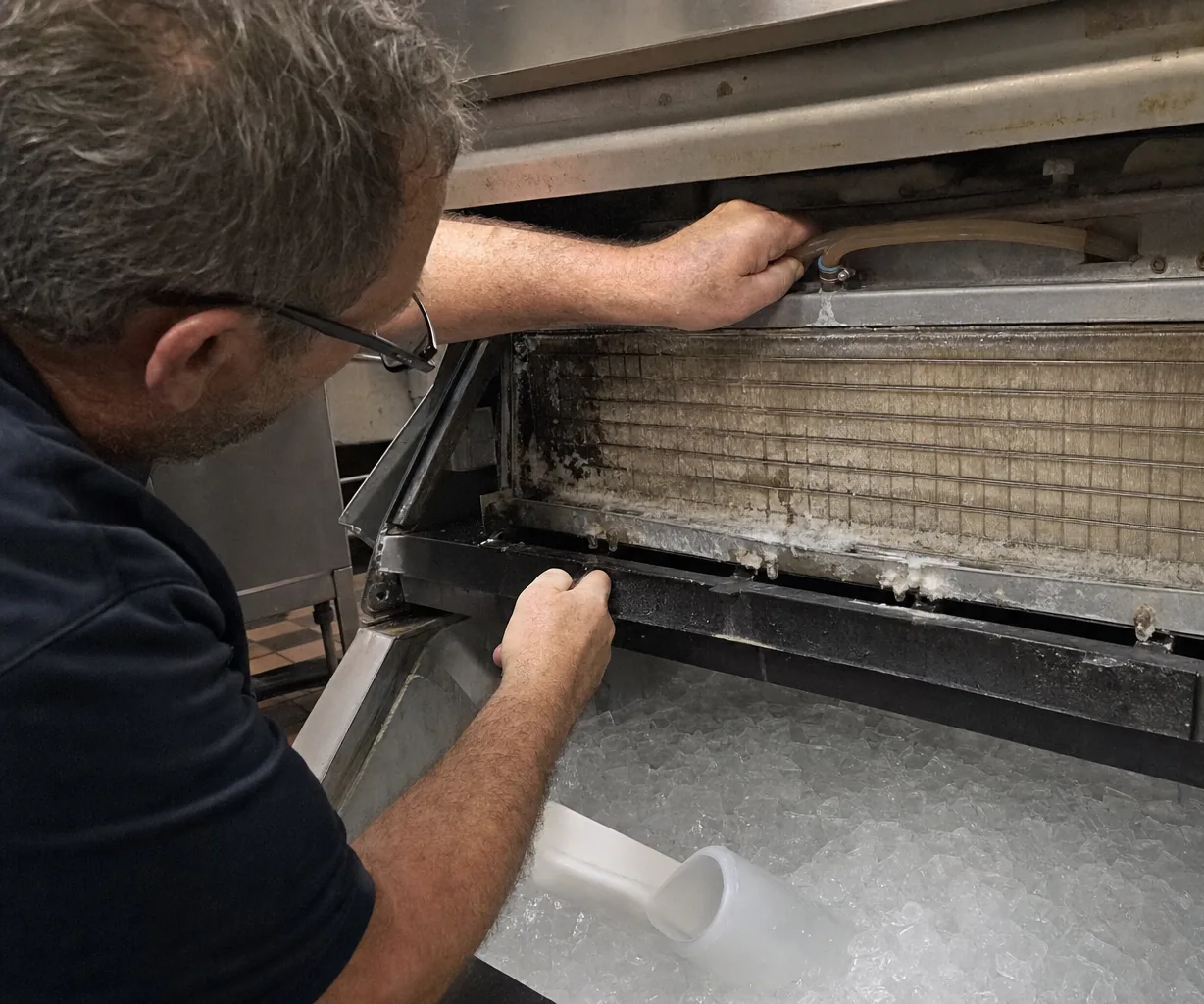
An outdoor refrigerator or ice maker is doing the hardest job on the property. It is rejecting heat into an ambient that is hot and humid, through a condenser that collects salt and sand continuously, and it usually has no cool night to recover in. Condenser cleaning is not optional maintenance out here — it is the whole difference between a unit that lasts and one that runs at its limit until the compressor gives up.
After water
Anything at deck level near the ocean or the Intracoastal can end up standing in salt water in a surge. Nothing that has been submerged gets switched on to see whether it survived. Salt water dries and leaves a conductive residue behind, which keeps bridging connections for months afterwards. Inspect first, then power.
A schedule that actually works
Rinse with fresh water and dry. It is dull, it is free, and it is the single biggest lever there is.
Cover it once it is cool, with a cover that breathes. A tight cover on warm metal traps damp against steel all night.
Have the burners and the ignition looked at once a year, in the spring, and the outdoor refrigeration condenser cleaned at the same time. A burner set ordered in March is an entirely different experience to one ordered the week people arrive.