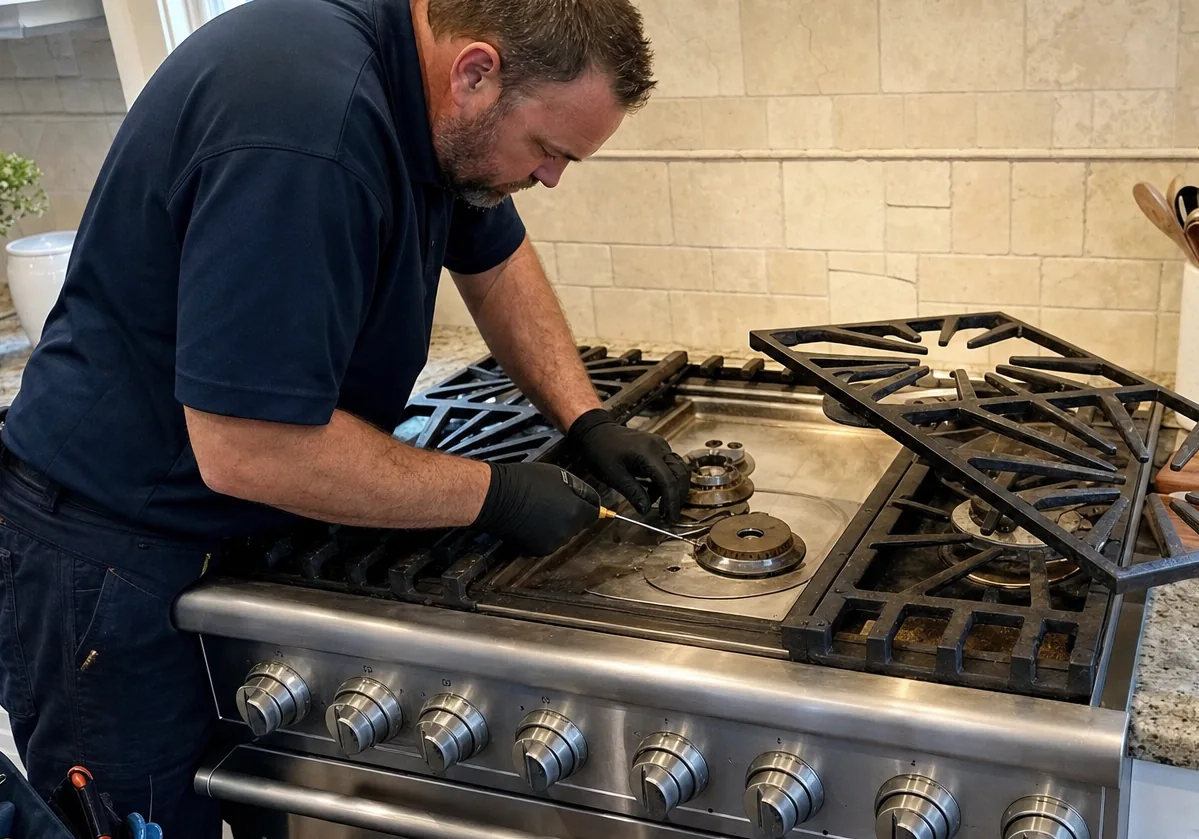
Outdoor kitchens are common at the beaches, and they take more punishment than anything else we work on. An indoor range gets salt air that has come in through a window. A built-in grill on an open deck four blocks from the Atlantic is in that air permanently, wet with dew most mornings, and hot enough on the surface during the day to drive whatever landed on it into the metal.
The honest framing is this: outdoor cooking equipment here has consumable parts, and planning for that is cheaper than being surprised by it.
Burners
Burner tubes are the part that goes. Corrosion works from the inside as well as the outside — combustion products and moisture sit in a tube overnight — and the failure shows as an uneven flame along the tube length before anything is visible. Once the ports have opened up or the seam has split, the flame pattern collapses, the grill loses its top end, and no amount of cleaning brings it back.
A burner that has holes in it is replaced. There is no repair for that and anybody offering one is wasting your money.
Ignition
Spark ignition outdoors fails for the same reason it fails indoors, only faster. The electrode sits in the weather, the ceramic insulator picks up a salt film, and the spark starts leaking to ground instead of jumping the gap. Clicking with no light is nearly always the electrode, its gap, or the ground path — rarely the module.
The other outdoor-specific cause is a wet or corroded connection at the module end. Grill wiring runs through a cabinet that gets rained into and hosed down, and the connectors in there are the ones to check before ordering anything.
Grates, hoods and the cosmetics
Cast grates pit. Stainless clouds and develops a rusty bloom that is usually surface tea-staining rather than the panel failing. We will tell you which one you have. Replacing a hood panel because it has gone spotty is money that would be better spent on the burners that are actually near the end.
Knobs and valve stems that have gone stiff are worth attention, because a valve forced when it is stiff is a valve that will end up leaking. That is a lubrication and seal job while it is early.
After a storm
Deck-level equipment near the ocean and along the Intracoastal can take standing water in a surge event. Anything that has been submerged — burner assemblies, igniter modules, outdoor refrigeration compressors — is inspected before it is switched on, not after. Salt water in an electrical enclosure does not dry out and go back to normal; it leaves a conductive residue that keeps working on the connections for months.
What actually extends the life
Rinse it with fresh water and dry it. Cover it when it is cool, never while it is warm, and use a cover that breathes rather than one that traps damp against the steel. Get the burners looked at on a schedule instead of when they fail, because a burner ordered in the spring is a different conversation to one ordered the day before people arrive.
The visit
$80 flat diagnostic, credited toward the repair. It covers every burner under flame, the ignition system end to end, gas supply and connections, the rotisserie if one is fitted, and any outdoor refrigeration in the same run. Written estimate before anything is ordered. Genuine OEM parts, 90 days labour, 365 days parts.