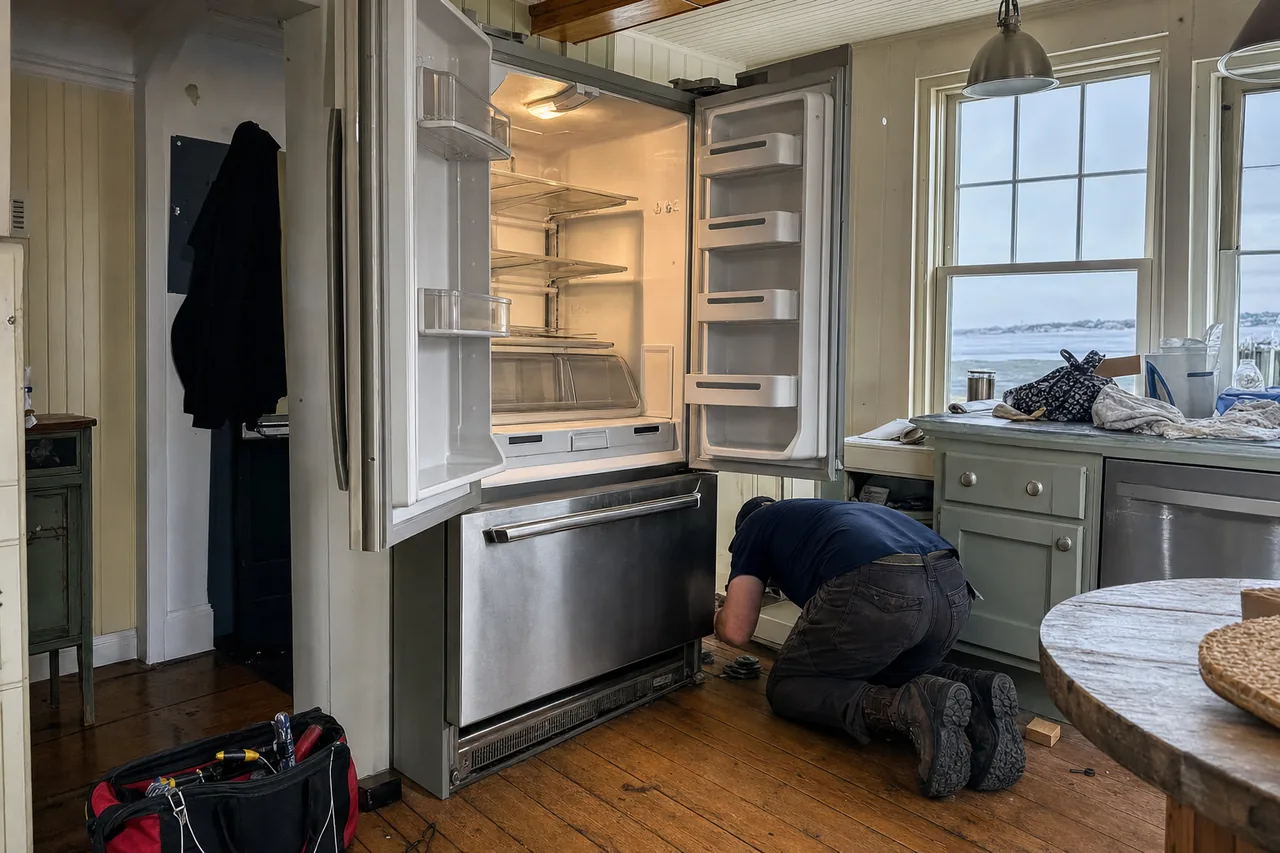
Jacksonville Beach sits in Duval County, a few streets back from the Atlantic at its widest, and the equipment here does not age the way the manufacturer’s service interval assumes. Inland, an appliance wears on duty cycles: you can predict roughly when a range will want attention from how often somebody cooks on it. Here the machine is being worked on whether it is switched on or not.
The Atlantic is close enough that chloride sits on everything, and it does not wash off in a way that helps. Burner grates and caps pit under a chipped porcelain coat. Hood blowers and their housings corrode from the inside of the duct outward. Stainless clouds and then stains, which is usually the first thing a homeowner notices and the last thing that actually matters. Outdoor kitchens take the worst of it, because nothing out there ever gets a break from it.
What that changes about a service call is the order of investigation. On a warm-compartment call the first question is airflow, not refrigerant. On a burner that clicks after it has lit, the first question is the electrode and its ceramic, not the spark module. On an intermittent control the first question is the supply. Working outward from the cheap and common to the expensive and rare is not caution, it is what the failure pattern on this coast actually rewards.
The two housing stocks
The 1st-to-5th Street core and South Jacksonville Beach hold a lot of older beach cottages, and those kitchens were not laid out for a professional range. Cabinet openings are frequently narrower than the appliance, and the circuit behind the wall was sized for something much smaller.
The newer construction, including a good deal of what has gone up around Isle of Palms, arrives with the full built-in package from the start. Different problem: those are heavy units in raised-slab and second-floor kitchens, and pulling a professional range out for service is a genuine logistics question before it is a repair question. That gets planned before the visit, not discovered during it.
The three beach towns are not one place
Atlantic Beach, Neptune Beach and Jacksonville Beach run into each other on the map and behave differently on a job sheet. The exposure is much the same along the whole strip — the same ocean, the same prevailing air — but the buildings are not, and the buildings decide what a repair costs.
Atlantic Beach carries a lot of substantial renovation work over older shells, which is where ducting and circuits get inherited rather than replaced. Neptune Beach is the smallest and densest of the three, with narrow streets, tight lots and short driveways, so the approach to the house is part of the plan. In Jacksonville Beach itself the split is street by street: the numbered streets nearest the ocean hold the oldest kitchens, and the newer construction west and south arrives with a full built-in package from the start.
That is why each of them gets its own page rather than a paragraph with the place name swapped.
The order things fail in
Across Jacksonville Beach the pattern is consistent enough to plan around.
Ventilation goes first, because a hood’s entire job is to pull outside air through itself. Blower housings corrode, wheels go out of balance, and the top speed is the first setting to stop working.
Outdoor kitchens go next, and for the same reason with none of the shelter. Burner tubes split, igniter electrodes lose their spark to a salt film, and any outdoor refrigeration is running its condenser in the worst conditions on the property.
Cooking surfaces follow. Burner caps pit under a chipped porcelain coat, then rock on their seats and throw the flame pattern out.
Built-in refrigeration is slower and quieter. The condenser packs with a salt-and-sand deposit that does not vacuum off the way ordinary dust does, run times climb, and the fresh-food side is the first compartment to lose the argument.
Water-fed equipment is on its own clock entirely, and it is the one group that degrades without ever reporting a fault. An ice maker that has lost fill volume still runs its cycle to the same timer and simply turns out short or hollow cubes; a dishwasher that is struggling to reach temperature just runs longer, because the control is watching a thermistor rather than a clock. Neither has broken. Both are worth catching at the valve, the inlet screen and the spray-arm geometry, which are small parts, rather than at the assembly, which is not.
Storms
The beaches run roughly sixty-eight thunderstorm days a year. What that does to a kitchen full of built-in equipment is rarely dramatic — it is a slow aging of control electronics through repeated brief outages and small transients, which shows up as intermittent faults rather than dead appliances. Coastal grounding hardware corrodes too, so on any control fault here the supply gets measured before a board goes on an estimate.
How we work
Monday to Friday 8:00am to 6:00pm, Saturday 9:00am to 4:00pm, by appointment. There is no after-hours or emergency call-out and we do not advertise one.
The diagnostic is $80 flat and comes off the repair if you go ahead. A written estimate comes before anything is opened up or ordered. Parts are genuine OEM, with 90 days on labour and 365 days on parts.
Viking equipment only. Nothing else comes in the van.