Built-in refrigeration is the most expensive thing in the kitchen to replace and the least likely to tell you it is in trouble. A range fails loudly. A built-in column or side-by-side degrades for months, holding temperature the whole time, and only stops when something has already been running at the edge of its capacity for a season.
Airflow before refrigerant
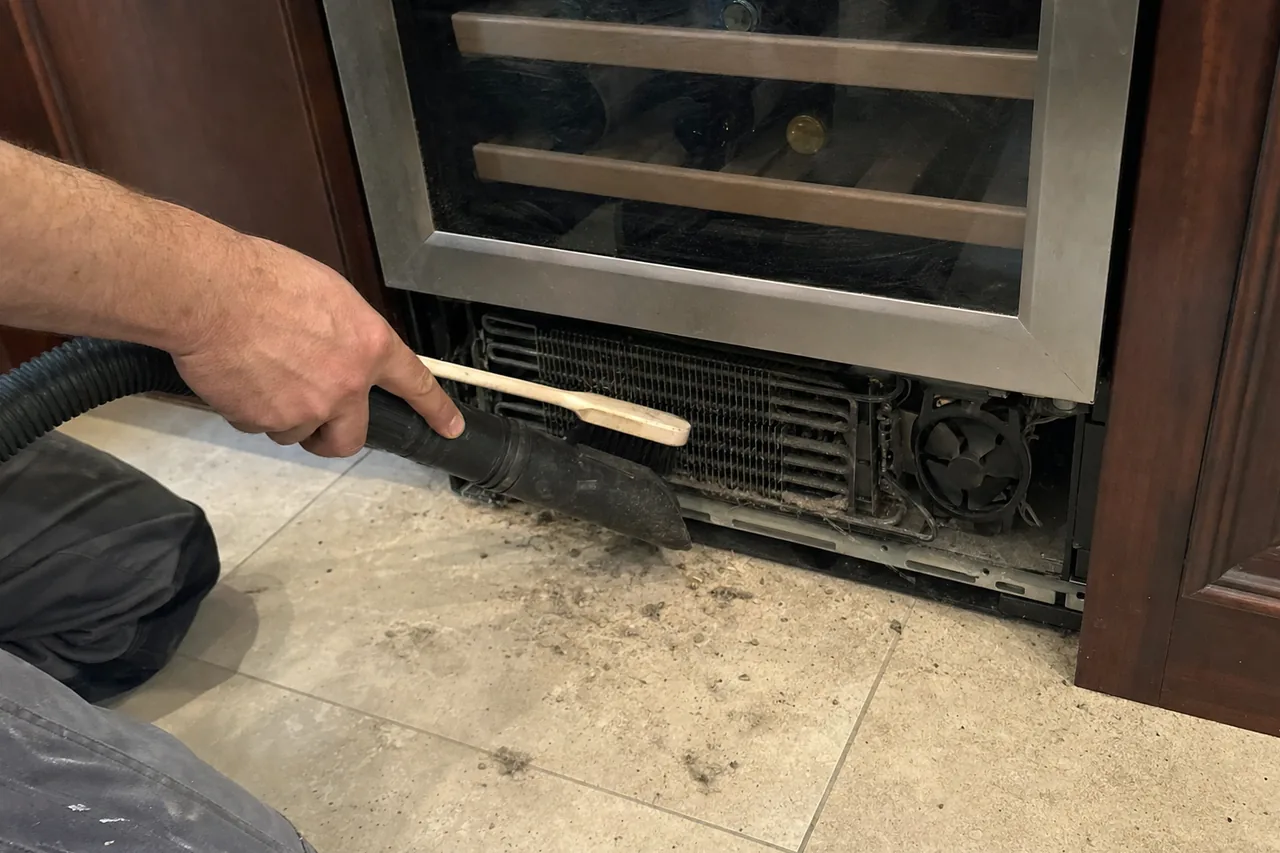
The first question on any warm-compartment call at the beach is airflow, not refrigerant. A built-in rejects its heat through a condenser hidden in the grille space, and that coil pulls kitchen air through itself continuously. Three blocks from the Atlantic, the air it pulls carries salt and fine sand along with the usual dust, and the deposit that builds on the fins is not the soft grey felt you see inland. It packs.
A blocked condenser makes the compressor run longer to move the same heat. The compartment stays at setpoint, the run time climbs, and the first thing the homeowner notices is that the unit never seems to stop. Left long enough, the head pressure work eventually shows up as a warm fresh-food side while the freezer still looks healthy, because the fresh-food evaporator loses the fight first.
Cleaning the condenser properly on a coastal unit means getting the grille off and reaching the whole coil face, not vacuuming what is visible. On oceanfront blocks this is a recurring maintenance item, not a one-time repair.
Frost, drains and defrost
Water under the crisper drawers is almost always a blocked drain, and a blocked drain on a built-in is usually ice, not debris. The defrost cycle melts frost off the evaporator, the melt runs to a drain trough, and if the trough or the tube below it has frozen, the next cycle puts water where it can find a way out — which is under the drawers.
A defrost system that has stopped cycling correctly frosts the evaporator over until airflow through it collapses. The symptom pattern is the giveaway: gradual warming over days, not a sudden failure, and often a compartment that recovers briefly after the doors have been left shut overnight.
The ice maker
A built-in ice maker does three things in sequence: it fills a mold with a measured amount of water, freezes it for a set period, then warms the mold slightly to release the cubes. Almost every complaint traces back to one of those three, and the shape of the ice says which.
Short or hollow cubes mean the fill was small. The valve opens for the same number of seconds it always did and less water arrives, so the mold freezes what it got and releases on time. The fill valve orifice, the inlet screen and the water filter are the first three things to look at, and all three are small parts.
Cloudy, fused cubes point at the mold and its thermistor — the harvest is reading the wrong thing and the freeze has gone further than it should before the cycle moved on.
Inconsistent cubes, some fine and some not, usually mean the supply is restricting rather than the machine failing: a filter past its date, a saddle valve barely open, or a line kinked behind the cabinet.
Ice that has stopped entirely is a different list — the valve, the line, the mold heater, the bail arm or optics, and the harvest motor.
The point of separating those is money. An ice maker assembly is an expensive part and it is very often not the failed one. On a built-in, the water side gets checked end to end before the assembly goes anywhere near an estimate.
Storm season and the compressor
Control boards and inverter-driven compressors do not usually fail during the event that damaged them. Roughly sixty-eight thunderstorm days a year, plus the multi-day outages this coast has seen after major storms, leave electronics that work perfectly on the day the power comes back and behave strangely weeks later. A refrigerator that forgot a setting after a storm, or that has started cycling oddly a month afterwards, is worth mentioning with the date attached — it changes what gets measured first, and the supply and grounding get measured before a board is quoted.
Sealed system work
Opening a sealed refrigeration system requires EPA Section 608 certification, a federal refrigerant-handling credential issued by the Environmental Protection Agency. We hold it, and we treat sealed-system work as the last diagnosis rather than the first — because on coastal built-ins the far more common answer is airflow, defrost, a door seal or a drain.
What you get
A flat $80 diagnostic that covers temperatures in both compartments, condenser and evaporator condition, defrost operation, door seals, and the water side end to end. A written estimate before anything is opened. Genuine OEM parts, 90 days on labour, 365 days on parts.