Isle of Palms sits on the western, waterfront side of Jacksonville Beach, on the Intracoastal rather than the ocean. It is still 32250 and still Duval County, but the air is not doing the same thing here that it does four blocks east, and the appliances know it.
Humidity instead of chloride
At the surf line the dominant mechanism is chloride deposition: salt lands on metal and works into it. On the water side of the city the salt load is lower and the standing humidity is higher, especially on lots that back onto the water with little air movement between the house and the bank.
High humidity attacks differently. It does not pit a burner cap. It condenses.
That shows up in a specific list of faults:
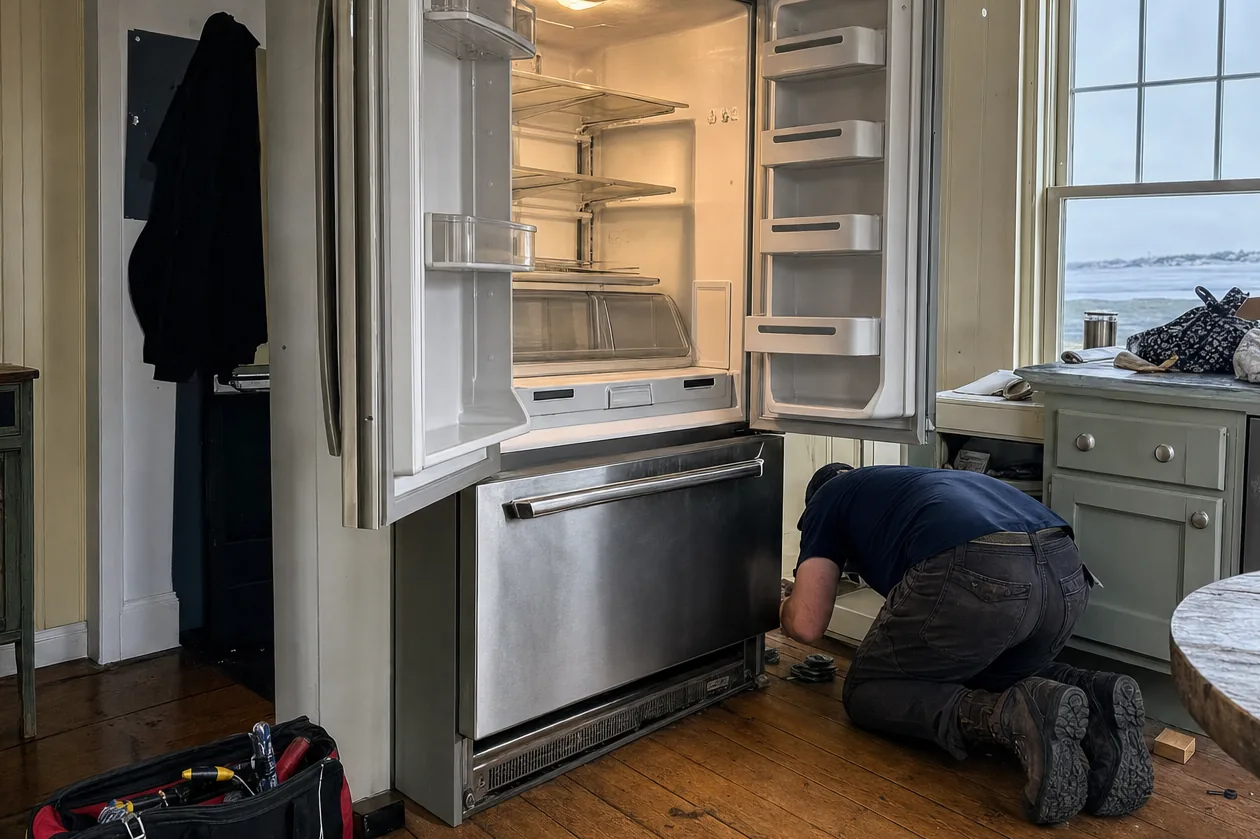
Refrigeration doors sweating on the outside. This is not always a fault at all — a built-in in a very humid room will condense on cool exterior surfaces — but it becomes one when the gasket has hardened enough to let humid room air into the cabinet, at which point the evaporator starts collecting frost it was never meant to handle.
Drain lines freezing on built-in refrigeration. More moisture entering the box means more melt water at every defrost, and a drain trough that would cope inland ices up here and puts water under the crisper drawers.
Control connections corroding at the crimp rather than the surface. Cooktop touch boards, wall oven controls and grill igniter modules all sit in enclosed cabinet spaces with no airflow, and the damage happens at the connector pins where you cannot see it.
Water at the door
Waterfront lots carry surge exposure that inland streets do not. When water has been in a garage, a ground-level storage room or an outdoor kitchen cabinet, the rule is simple and it is not negotiable: nothing that has been submerged in salt water gets switched on to see whether it works.
Salt water leaves a conductive residue behind when it dries. An igniter module or a compressor start relay that survived the water will often run for a few weeks and then fail, because the residue keeps bridging what it should not. Outdoor refrigeration and grill electronics at deck level are the usual casualties here, and they are inspected before power, not after.
The docks and the outdoor equipment
A lot of houses on this side of the city have a dock, a boat, and a run of outdoor cooking equipment to go with them. Outdoor refrigeration on the water side is working in a permanently humid ambient with a condenser that never gets a cool night, and it is the appliance most likely to be quietly running at its limit for years before it stops.
If there is one thing worth doing on a waterfront property, it is having the outdoor equipment looked at on a schedule instead of when it fails.
What gets checked, and in what order
Condensation calls are the ones most often misdiagnosed, because the obvious answer — a failed gasket — is frequently not the answer at all. On a built-in refrigeration call here the sequence is fixed:
Ambient first. Room temperature and humidity at the appliance, and where the room gets its outside air from. A cold surface in a room at eighty percent relative humidity condenses water, and that is physics rather than a fault.
Then the seal, all the way round, at several points and especially at the corners and along the hinge side. A strip of paper closed in the door should come out against real resistance.
Then alignment. A heavy built-in door can be out of true without the gasket being worn at all, and the cabinet it sits in can have moved — houses on the water move seasonally more than people expect. Alignment is usually adjustable, which makes it the most satisfying repair in the list: the part count is zero.
Then the perimeter heaters, which exist precisely to manage condensation on the frame and mullion, and which are a real fault when they have gone open.
Then the evaporator, for frost pattern, because the pattern tells you how long humid air has been getting in. Then the drain trough and tube. Only then does anything get ordered.
A gasket fitted to a door that is out of alignment is a gasket that will fail in the same place again, which is the whole reason for running it in that order.
Booking
By appointment, Monday to Friday 8:00am to 6:00pm and Saturday 9:00am to 4:00pm. $80 flat diagnostic credited toward the repair, written estimate first, genuine OEM parts. Viking equipment only.