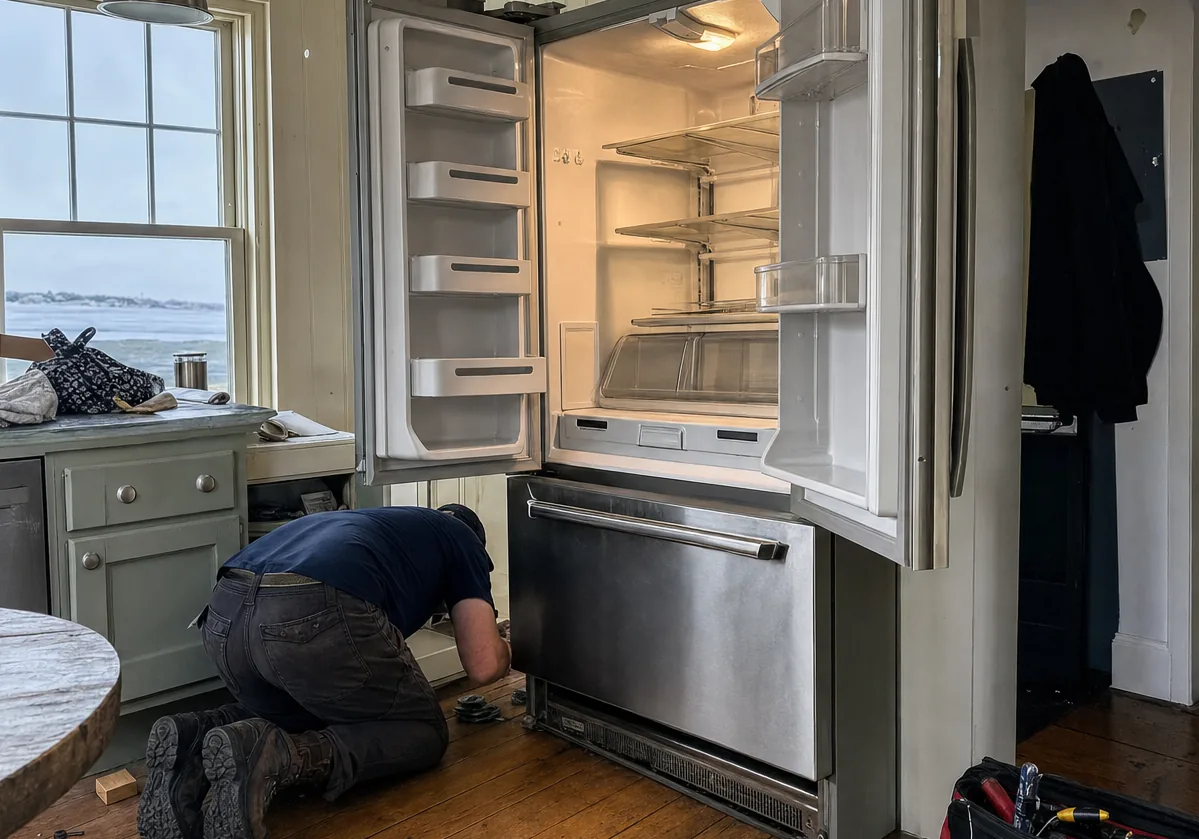
Atlantic Beach is the northern of the three beach towns in Duval County, and the thing that shapes a service call here is not the ocean — every town on this strip gets the ocean. It is that Atlantic Beach renovates rather than rebuilds. A great many kitchens here are new inside an older building, and when that happens the appliance is almost always the newest thing in the room while the duct behind it, the circuit feeding it and the opening holding it are not.
The appliance changed; the duct did not
A professional hood and a professional rangetop move far more air than the equipment they replaced, and the ductwork in a renovated kitchen is frequently the run that was already there. Every duct named on this page is kitchen exhaust: the run from the hood liner to the termination. The cooling side of an Atlantic Beach house — the air handler in the closet, the returns, the condenser on the slab — belongs to a mechanical contractor, and no part of it is work we take on.
That produces a specific and very common complaint: a hood that seems weak, or loud, or both, with nothing actually broken in it. The blower is doing what it was built to do and the system around it will not let it. What we look at, in this order:
- The duct diameter and whether it steps down anywhere along the run. A transition to a smaller pipe undoes the blower rating in a single fitting.
- The number and type of elbows. Every turn costs static pressure, and two tight turns close together cost more than the two of them apart.
- Flexible duct left in a run that should be rigid. It is a common shortcut and it is the single most effective way to make a good blower sound busy and move nothing.
- The termination and its damper. A backdraft damper that has corroded stiff will not open fully, and on this coast they do corrode stiff.
- Make-up air. A tight, well-sealed renovated house starves a large hood, and the symptom is a hood that pulls acceptably with a window open and poorly with the house shut.
None of that list is a part failure, and none of it is fixed by replacing the blower. Getting the diagnosis right here is mostly a matter of refusing to sell a motor to a duct problem.
Inherited circuits
The electrical side follows the same pattern. Wall ovens and induction surfaces in particular want a dedicated, correctly sized supply, and a kitchen that was rewired only as far as the visible outlets often did not get one.
The symptom reads as an appliance fault. A control that resets when the oven element cycles. A cooktop that drops a zone under load and behaves perfectly the next morning. Nuisance tripping that follows the kettle rather than the oven. Before a board is quoted, we measure voltage at the appliance under load, check the neutral and the ground, and find out what else is on the circuit. Fitting a control into a supply problem buys the same repair twice, and it is a genuinely expensive way to learn that.
Storms, and why they matter more on older service equipment
The beaches see roughly sixty-eight thunderstorm days a year, and the damage is rarely the dramatic kind. What we see is aging: repeated brief outages and small transients that leave a control intermittent rather than dead. Panels that light partly. Ovens that lose a function and get it back. Cooktop zones that answer one day and not the next.
Older service equipment and corroded coastal grounding hardware make that worse, because a ground path with resistance in it does not shunt transients the way the design assumed. It is invisible until somebody measures it, which is why on any control fault here the supply is measured first.
Access, since the kitchen came second
Where the millwork was finished around a built-in after installation, a panel has to come off before the machine can move. Where the opening was cut to the old appliance and trimmed to the new one, a wall oven may not come far enough forward to reach a hinge or a terminal block.
We ask about the opening, the surrounding cabinetry, the approach and the floor when the appointment is booked, because on a heavy built-in that is the part of the job that decides how long it takes and how many people it needs.
Booking
By appointment. Monday to Friday 8:00am to 6:00pm, Saturday 9:00am to 4:00pm. $80 flat diagnostic, credited toward the repair. Written estimate before any work starts. Genuine OEM parts, 90 days on labour, 365 days on parts. Viking equipment only.