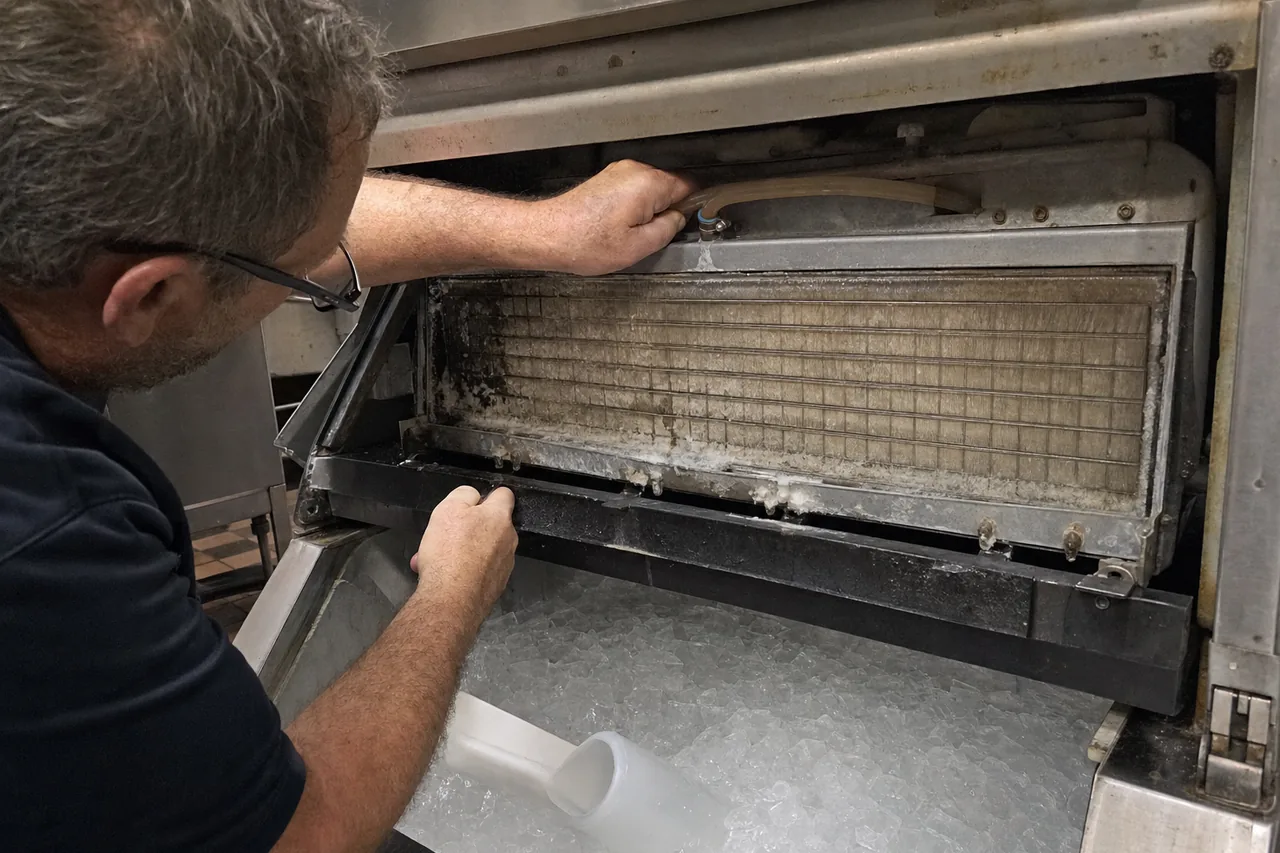
A built-in ice maker is a sequence of three operations and nothing more. It fills a mold with a measured amount of water. It freezes that water for a set period. Then it warms the mold slightly and releases the cubes. Fill, freeze, harvest.
Almost every ice complaint we get is one of those three drifting out of specification while the other two carry on exactly as designed — and because nothing has actually failed, the machine has no way to report it. It fills, it freezes, it harvests, it repeats, and the ice gets steadily worse over months while the household quietly adjusts to it.
The cube tells you where the problem is
When the fill volume drops, the valve opens for the same number of seconds it always did and less water goes in. The freeze time does not change, so the ice forms and releases on schedule and comes out short — visibly less than full height, or hollow at the top because there was never enough water to close the crown. Short cubes point at the valve, the inlet screen or the filter.
When the mold itself is insulated — by deposit, by a displaced mold heater, or by a sensor that has drifted — it takes longer to reach the temperature the thermistor is watching for. The harvest is late and the cubes come out cloudy and fused, because the freeze went further than it should have before the cycle moved on.
When the supply upstream is restricting, the fill is slow rather than small, and you tend to get inconsistent cubes rather than uniformly bad ones. Some batches are fine. Some are not.
Short cubes point at the valve. Cloudy fused cubes point at the mold. Random cubes point upstream. That is not a diagnosis, but it is a very good place to start, and it is something you can observe yourself before anybody comes out.
When it has stopped completely
No ice at all is a shorter list and a different one: the fill valve or its solenoid, the supply line or saddle valve, the mold heater, the bail arm or the optical sensor that tells the machine the bin is full, and the harvest motor or its gear train.
The bin sensor is worth its own sentence, because it is the cheapest thing on the list and it produces the most alarming symptom. A machine that thinks the bin is full simply stops making ice, with no fault indication and nothing mechanically wrong anywhere.
The water it fills with
JEA publishes tap-water hardness by ZIP, and Jacksonville Beach — 32250, this company’s home ZIP — is published at 292 ppm, about 17 grains per gallon. That is hard water by any reasonable measure, and it is why the fill orifice and the mold are the two places a machine here drifts first. It is also the whole argument for whole-house treatment: we do not fit it and have nothing to sell you there, but it is the single change that most affects how often you see us.
What is actually worth doing
Change the water filter on the schedule in the manual rather than when the ice starts tasting odd. A filter past its date restricts flow and adds a second problem on top of whatever the first one was.
If the cubes have gone short, have the fill valve and the inlet screen looked at before the assembly. A valve is a small part. An ice maker assembly is not, and it is very often not the failed component.
Do not run a general-purpose household descaler through a refrigeration ice maker on a whim. The mold, the thermistor and the seals in there were not designed around it.
And note the date if the machine started behaving oddly after a storm. Control electronics on this coast frequently misbehave weeks after the power event that aged them, and that timing changes what gets measured first.
Where the money goes
The reason we chase fill volume before assemblies is arithmetic. A valve, a screen, a filter and a sensor are inexpensive parts with straightforward access. An ice maker assembly, and worse a module fitted to a specific production run, is neither. On a built-in the water side gets checked end to end, with the figures written down, before an assembly goes anywhere near an estimate.
If the answer genuinely is the assembly, it will be on a written estimate with the reason attached — and if we cannot explain why the part failed, the diagnosis is not finished yet.